The Kotor Fortress hike is the steep climb from Kotor Old Town through the historic city walls to San Giovanni Fortress, also called St John’s Fortress. It is the best short hike in Kotor for a panoramic view of the red roofs, the Bay of Kotor and the mountains enclosing the town. Most reasonably fit travelers need about 60–90 minutes to climb, then 45–75 minutes to descend, with extra time for photographs and rest.
The hike is rewarding, but it is not a casual paved promenade. Expect many uneven stone steps, exposed sections, limited shade and slippery surfaces after rain. Start early, carry water, wear shoes with reliable grip and check the entrance board locally for the current opening hours and ticket price. This guide explains the official city-walls route, the alternative Ladder of Kotor approach, who should attempt the climb and how to fit it into a day in Kotor.
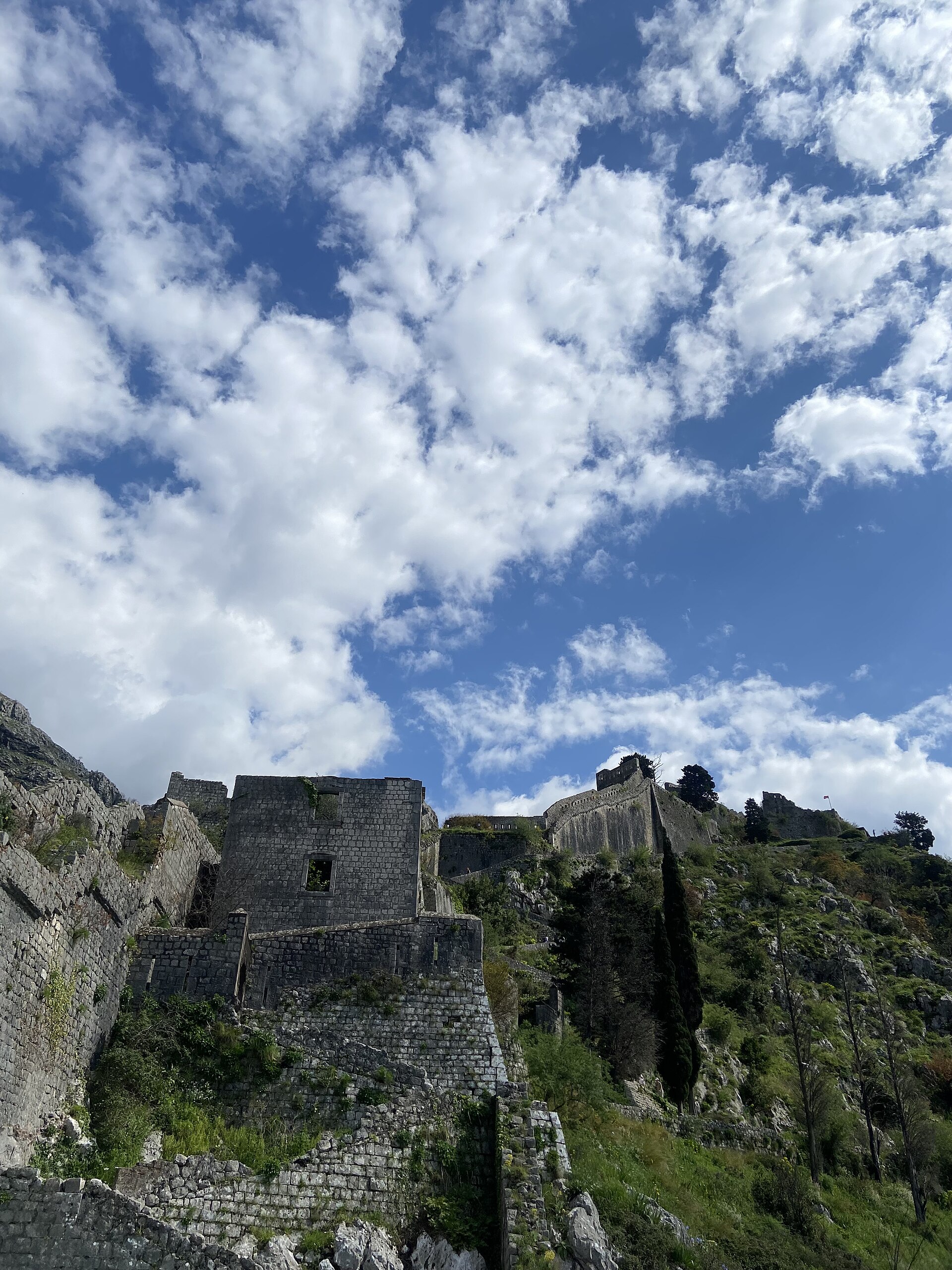

Kotor Fortress hike: the quick answer
The best plan is to enter the Kotor city walls shortly after opening, climb steadily to San Giovanni Fortress, and return by the same official route before the strongest heat. Allow two and a half to three hours for a comfortable round trip. The climb suits active adults, older children accustomed to hiking and travelers who value a big viewpoint more than an easy walk.
At a glance:
- Starting point: inside Kotor Old Town, behind the eastern side of the historic center
- Highest objective: San Giovanni or St John’s Fortress above the town
- Typical round-trip time: about 2–3 hours, including short rests
- Difficulty: moderate to strenuous because of steep, uneven steps and heat
- Best time: early morning; late afternoon can work when official access hours and daylight allow
- Bring: water, sun protection and closed shoes with grip
- Avoid: midday summer heat, wet stone after heavy rain and rushing the descent
- Best for: viewpoints, photography, active couples, solo travelers and a half-day Kotor plan
- Not ideal for: strollers, limited mobility, severe vertigo or anyone unprepared for sustained climbing
The route is compact but physically demanding. Distance alone is misleading: elevation, repetitive steps and summer temperatures determine how hard it feels.
What exactly are the Kotor city walls and San Giovanni Fortress?
Kotor’s fortifications connect the medieval Old Town at sea level with defensive positions high on the mountain slope. The walls form part of the wider Natural and Culturo-Historical Region of Kotor, recognized by UNESCO. The system includes gates, bastions, stone stairways, the Church of Our Lady of Remedy and the upper fortress commonly called San Giovanni or St John’s Fortress.
Travelers use several names for the same outing: Kotor Fortress hike, Kotor city walls hike, St John’s Fortress hike and San Giovanni Fortress hike. In practical terms, they usually mean the official ascent from Old Town through the fortified walls to the upper ruins.
The Church of Our Lady of Remedy is an intermediate landmark and a worthwhile objective in its own right. It provides an elevated view without requiring every visitor to complete the full climb. The upper fortress is rougher, more exposed and more expansive. From there, the classic view looks down over the triangular Old Town, the inner bay and the steep limestone walls around Kotor.
This is not a polished modern attraction at every step. The historic fabric, irregular stairs and ruined sections are part of the experience. Treat the fortifications as a heritage site rather than an outdoor gym: keep to established paths, do not climb fragile masonry and carry all rubbish back down.
Where does the Kotor Fortress hike start?
The official hike starts inside Kotor Old Town, where signs lead uphill toward the city walls and fortress. Travelers commonly approach from the lanes behind the Church of St Mary and the northern/eastern side of the old center. Access arrangements can change, so follow the official signs and staffed entrance rather than relying on an old pin that promises a free gate.
A simple arrival sequence is:
- Enter Kotor Old Town through the Sea Gate or another public gate.
- Walk through the pedestrian lanes toward the eastern hillside.
- Follow signs for the city walls, fortress, San Giovanni or St John.
- Read the entrance board for current price, hours and safety notices.
- Use the official entrance and begin the stone stairway.
If arriving on a cruise day, build in extra time. The old streets and entrance area can become busy after ships disembark. Starting before the main excursion groups gives you cooler conditions and more space on narrow steps. Our Kotor cruise port guide explains how to prioritize the fortress when you have only one day.
Drivers should not expect to park beside the trail. Park outside the pedestrian Old Town, then walk to the entrance. The practical driving in Montenegro guide covers road and parking expectations, while travelers coming from the central coast can compare options in the Kotor to Budva transport guide.
The official route, step by step
Stage 1: Old Town to the lower walls
The first section begins almost immediately with stone stairs and switchbacks. It is a useful reality check: if the heat or footing already feels uncomfortable, turn the Church of Our Lady of Remedy into your goal rather than forcing the summit.
Look back periodically. The view develops quickly, and lower viewpoints can be excellent in softer morning light. Short, frequent pauses are more efficient than one long stop after overheating. Stay to the side when resting so other hikers can pass safely.
Stage 2: Church of Our Lady of Remedy
The small church on the slope is the first major landmark. Many visitors reach it in roughly 20–40 minutes, depending on pace, crowds and photo stops. It offers a satisfying view over the Old Town and bay and can serve as the turnaround point for families or travelers with limited time.
This is also where the climb starts to feel more exposed. Shade is inconsistent, the stone radiates heat and the upper fortress still appears deceptively far away. Reassess your water, energy and weather rather than continuing automatically.
Stage 3: Upper walls and fortress approach
Beyond the church, the route continues through long stair sequences and broken fortification sections. The surface varies. Some stretches have defined steps; others require more attention to loose or polished stone. Use railings only where they are secure and give descending hikers room.
The upper approach provides increasingly wide views into the bay. Clouds can build over the mountains even when the coast began clear, so watch the sky. In thunder, strong wind or heavy rain, an exposed historic wall is not the place to wait out the weather.
Stage 4: San Giovanni Fortress
The upper fortress is the main destination, but do not treat every wall as a viewpoint platform. Choose stable, established areas and remain behind barriers. The best panorama does not require balancing on masonry.
Rest, drink water and allow your breathing to settle before starting down. Fatigue causes more trouble on descent than many hikers expect. The town below may look close, but thousands of uneven downward steps demand concentration.
Stage 5: Return to Kotor Old Town
For most travelers, the simplest and clearest return is down the official city-walls route. Descend deliberately, place your full foot when possible and avoid overtaking on narrow stairs. Trekking poles can help some hikers, but they must not obstruct others.
Once back in the Old Town, plan a slow meal or shaded break rather than another immediate climb. Browse the wider Montenegro Experience journal for a low-effort afternoon idea or explore available experiences and products that complement a morning on the walls.
How difficult is the Kotor Fortress hike?
The Kotor Fortress hike is moderate in cool, dry conditions and can feel strenuous in summer heat. It does not require technical climbing, but it does require sustained uphill effort, confidence on uneven stairs and enough control for a careful descent.
The main difficulty factors are:
- substantial elevation gained over a short horizontal distance;
- hundreds of irregular stone steps;
- little dependable shade;
- surfaces polished by heavy foot traffic;
- crowding at passing points;
- heat reflected from pale stone;
- a descent that stresses knees and demands balance.
A traveler who regularly walks hills may find the route straightforward if starting early. Someone used only to flat city walking may find it much harder than expected. Fitness labels are subjective, so use concrete tests: can you climb stairs continuously for 20 minutes, recover quickly and descend uneven ground without instability? If not, aim for a lower viewpoint.
Children should be judged by hiking experience rather than age alone. Active older children who follow instructions may enjoy the challenge. Young children who need carrying create a serious burden on steep steps. The route is unsuitable for strollers.
Travelers with knee problems, balance limitations, significant vertigo or cardiovascular concerns should consider the lower walls only or choose a different viewpoint. A boat journey on the bay or a visit to nearby Perast offers dramatic scenery with far less physical strain.
How long does the Kotor Fortress hike take?
Allow 2–3 hours for the round trip, and up to 3.5 hours if you stop often for photographs. Fast hikers may complete it sooner, but speed should not be the goal on crowded historic steps.
A realistic comfortable schedule is:
- 10–15 minutes to locate the entrance and check access information;
- 25–40 minutes from Old Town to Our Lady of Remedy;
- another 35–60 minutes to reach the upper fortress;
- 15–30 minutes at viewpoints;
- 45–75 minutes to descend.
Add a margin if a cruise ship is in port, rain is possible or your group has mixed fitness. If you have only two hours total before a transfer, the church viewpoint is a safer target than the summit. Never cut your return margin so closely that you need to run on stone.
Tickets, opening hours and the “free route” question
Use the official entrance and confirm the current Kotor city walls ticket price and opening hours on the posted board. Fees and access arrangements can change by season and year; an old blog post or map review is not a reliable basis for bypassing a staffed heritage entrance.
Travel discussions often mention a supposedly free approach via the Ladder of Kotor, a historic switchback trail outside the walls. This is not simply an interchangeable ticket-free entrance. Connections between the ladder, hillside paths and fortifications may involve rough terrain, unofficial openings or access conditions that change. A hole or shortcut shown in an old video may be closed, unsafe or inappropriate to use.
Choose the official route if your main goal is the city walls and fortress. It is easier to follow, puts the heritage sequence in context and avoids uncertainty about boundaries. Choose the Ladder of Kotor only as a separate hike after checking current trail conditions, daylight, weather and legitimate access. Do not climb fences, force gates or cross signed private property.
Carry a payment method accepted locally, but do not assume cards always work at a small seasonal entrance. Having some euros is sensible. Keep your ticket until leaving.
Best time of day and best season
Early morning is the best time for the Kotor Fortress hike because temperatures are lower, stone steps are less crowded and the light is often clearer. In July and August, a midday ascent can turn a moderate heritage walk into a heat-risk decision.
Spring
April and May usually bring comfortable hiking temperatures and greener slopes, although rain can make the stone slippery. Check the immediate forecast, not just the daily icon. After a downpour, waiting for surfaces to dry may be the wiser plan.
Summer
June through August offers long daylight but the greatest heat and crowd pressure. Begin as early as official access allows. Carry more water than you think you need, use sun protection and abandon the summit if anyone develops headache, nausea, dizziness or unusual weakness.
Autumn
September and October can provide a strong balance of warm conditions and fewer peak-season crowds. Daylight shortens, and storms can arrive quickly around the bay. Our Montenegro in September guide helps place Kotor in a wider trip.
Winter
Winter can be quiet and beautifully clear, but rain, wind and reduced operating hours become more relevant. Never assume the entrance is staffed or open based on summer information. Wet historic stone deserves extra caution.
Late afternoon can be attractive for light and lower temperatures, but only if the official access schedule leaves enough time to return before closure and darkness. Do not depend on a phone torch as a hiking plan.
What to wear and carry
For the Kotor Fortress hike, wear closed walking shoes or trail shoes with a grippy sole. Heavy boots are not essential in normal dry weather, but smooth sandals, flip-flops and fashion shoes are poor choices.
Carry:
- at least one generous bottle of water per person, more in heat;
- sun hat, sunglasses and sunscreen;
- a charged phone with offline map access;
- a light layer outside summer;
- a compact rain shell when showers are possible;
- any personal medication;
- a small amount of cash;
- a snack if you expect a slow ascent.
There may be seasonal vendors, but do not make your safety depend on them. Toilets and full services are in or near Old Town, not reliably available throughout the climb. Start fed and hydrated, but avoid a heavy meal immediately before ascending.
Official city walls or the Ladder of Kotor?
Choose the official city walls for the classic fortress experience; choose the Ladder of Kotor for a longer, rougher mountain walk. They overlap visually but serve different traveler intents.
The official walls are best when you want:
- the direct historic route from Old Town;
- Our Lady of Remedy and San Giovanni Fortress;
- clearer navigation;
- a compact half-day activity;
- easy integration with sightseeing in Kotor.
The Ladder of Kotor is better when you want:
- a longer series of mountain switchbacks;
- a trail-focused outing rather than primarily a monument visit;
- broader elevations and changing perspectives;
- more physical distance and route planning.
Do not improvise a combined loop unless you have reliable current information about access points and trail conditions. Online descriptions age quickly, while gates, walls and paths can change. An out-and-back on the official route is the most predictable plan for a first visit.
Common mistakes to avoid
Starting at midday in summer
This is the most consequential mistake. Limited shade, hot stone and sustained climbing increase dehydration and heat illness risk. An early alarm is a better solution than trying to “push through.”
Trusting an old ticket price or shortcut
Prices, hours and access points change. Check the entrance board and follow legitimate routes. Saving a fee is not worth trespassing or scrambling through unstable masonry.
Underestimating the descent
Reaching the fortress is only half the outing. Save water and energy for coming down. Move slowly when steps are polished or crowded.
Wearing poor footwear
The route is full of uneven stone. Shoes with grip improve comfort and control, particularly on descent.
Blocking narrow stairs for photos
Use wider stopping points and remain aware of people behind you. Drones and commercial photography may be regulated; check local rules before bringing specialist equipment.
Making the summit mandatory
The church and lower walls already deliver a memorable view. Turning around because of heat, rain, fatigue or time pressure is sound travel judgment, not a failed hike.
How to combine the hike with a day in Kotor
Pair an early fortress climb with Old Town sightseeing, lunch in the shade and a low-effort afternoon by the bay. This sequence avoids stacking strenuous activities during the hottest hours.
A balanced day looks like this:
- 07:00–10:00: fortress hike, adjusted to current opening time;
- 10:00–11:00: drink, breakfast or coffee and recovery;
- 11:00–13:00: cathedral, lanes, squares and selected museums;
- 13:00–15:00: lunch and rest;
- late afternoon: bay walk, short boat experience or transfer to Perast.
If you have two days, use the second for a wider Bay of Kotor excursion. The Bay of Kotor travel guide explains the region, while 48 hours in Kotor gives a practical weekend structure. Travelers comparing bases can also look at Budva for beaches and nightlife or browse the main places in Montenegro hub before deciding where to stay.
Frequently asked questions
Is the Kotor Fortress hike worth it?
Yes, if you can manage steep uneven steps and start in suitable weather. It delivers the most recognizable elevated view of Kotor in a compact outing. It is less worthwhile if heat, crowds or mobility limitations would turn the climb into an unsafe ordeal.
How hard is the hike to Kotor Fortress?
It is moderate to strenuous rather than technical. The challenge comes from sustained elevation, many stone steps, exposure to sun and a careful descent.
How much time should I allow?
Plan 2–3 hours for the round trip. Add time for crowds, photography or a slower group. The Church of Our Lady of Remedy is a sensible shorter objective.
Can I hike Kotor Fortress in sandals?
Closed shoes with grip are strongly preferable. Smooth sandals and flip-flops reduce control on uneven or polished stone, especially while descending.
Is the Kotor Fortress hike suitable for children?
It can suit active older children with hiking experience and close supervision. It is unsuitable for strollers, and carrying a young child on steep steps can be exhausting and risky.
Can I hike for free via the Ladder of Kotor?
Do not treat the Ladder of Kotor as a guaranteed free entrance to the fortress. It is a separate mountain route, and connections or access rules may change. Use the official entrance for the city walls and verify current conditions for any independent trail.
What happens if it rains?
Stone steps can become slippery, and exposed upper sections are unpleasant in wind or thunderstorms. Delay, shorten or skip the climb after heavy rain. Kotor has enough indoor and low-level alternatives to avoid taking unnecessary risk.
Can I do the hike during a cruise stop?
Yes, if your ship schedule provides a safe margin. Start early, monitor return time and consider turning around at the church if the route is crowded. Never let the summit compromise your all-aboard deadline.
Final planning advice
The Kotor Fortress hike is best approached as a short mountain outing, not merely another Old Town attraction. Start early, use the official entrance, verify current ticket and access details, carry water and allow enough time for a controlled descent. The upper fortress gives the grandest panorama, but the lower walls and Our Lady of Remedy still provide an excellent experience when weather, fitness or time argues for a shorter climb.
After the hike, continue exploring Kotor, plan an easier visit to Perast, or use the Montenegro Experience products hub to find a complementary experience. Good Montenegro itineraries balance ambitious viewpoints with slower time beside the bay—and this climb is most memorable when it is not rushed.