The best Montenegro scenic train journey is the daylight ride from Bar or Podgorica north along the Belgrade–Bar railway. In a few hours, the line moves from the Adriatic hinterland past Lake Skadar, through the Morača valley and into a landscape of ravines, bridges and mountain stations. You do not need to travel all the way to Belgrade to enjoy its strongest Montenegro scenery: a Bar–Kolašin day trip or a one-way transfer to the mountains captures much of the drama.
This guide is for travelers deciding whether the train deserves a place in a Montenegro itinerary, especially visitors without a car, rail enthusiasts, photographers and anyone wanting a slower alternative to another road transfer. It explains which section to ride, how to choose a daytime service, what can go wrong, which side offers the best views, and how to combine the railway with Lake Skadar, Kolašin or the coast.
Quick recommendation: Ride northbound in daylight, ideally from Bar or Podgorica to Kolašin. Keep your schedule flexible, bring water and food, and treat the journey as an experience rather than a precision-timed airport connection.
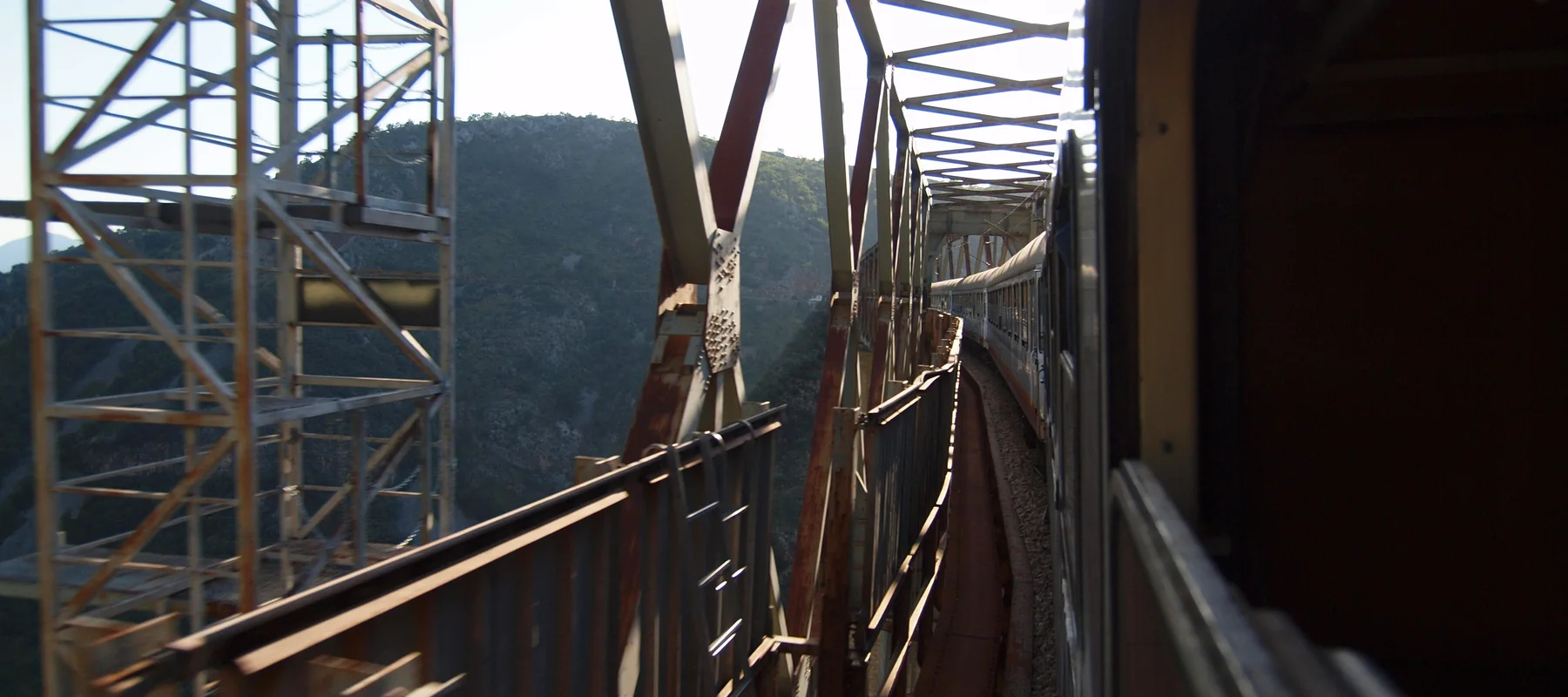
The Belgrade–Bar railway at Mala Rijeka Viaduct. Photo by Orjen via Wikimedia Commons, licensed under CC BY-SA 4.0.
Is the Montenegro scenic train worth taking?
Yes—the Montenegro scenic train is worth taking if you value landscape and slow travel more than speed or certainty. The railway reveals terrain that is difficult to appreciate from the main roads: steep slopes falling toward the Morača, abrupt tunnel-to-bridge transitions, distant villages and a broad view over Lake Skadar. It also gives car-free travelers a practical connection between Bar, Podgorica and Kolašin.
It is less suitable if you have a same-day flight, dislike uncertainty, need fully step-free travel, or expect luxury sightseeing-car service. This is a working railway, not a curated panoramic train. Rolling stock and onboard facilities can vary, delays happen, windows may not always be spotless, and announcements may be limited. Those tradeoffs are exactly why expectations matter.
Choose the train for:
- a memorable transfer from the coast toward Kolašin;
- a low-stress sightseeing day from Podgorica;
- a car-free segment that complements a wider public-transport itinerary;
- photography and railway engineering;
- cooler mountain air after several coastal days.
Choose a road transfer instead when every hour is fixed, you carry mobility equipment that has not been confirmed with the operator, or you need to reach a remote mountain hotel directly.
Which section of the Belgrade–Bar railway has the best views?
For most visitors, the best scenic section runs between Podgorica and Kolašin, while starting in Bar adds a beautiful approach beside Lake Skadar. The line from Bar first crosses lower coastal country and then passes the lake zone before reaching Podgorica. North of the capital, it climbs sharply into Montenegro's mountain interior through a succession of tunnels, viaducts and exposed valley views.
Bar to Virpazar: coast-to-lake transition
Bar is the railway's Adriatic terminus and a logical starting point if you are staying on the southern coast. The early section does not deliver uninterrupted sea views, but it provides the narrative that makes the whole trip satisfying: port city, lowland, lake basin, capital and mountains in one continuous ride.
Virpazar is the rail gateway to Lake Skadar. The station is not a complete lake experience by itself, so do not expect to step from the platform directly onto a boat. Stay overnight or build in enough time to reach the village, arrange a cruise and return without relying on the final possible connection.
Virpazar to Podgorica: Lake Skadar panoramas
This section brings open water, wetlands and mountains into view. Conditions change by season: winter and spring can produce a broad expanse of water, while summer emphasizes reed beds, channels and heat-hazed ridges. The railway crosses the lake system rather than circling every picturesque shoreline village, so think of it as a panoramic introduction rather than a substitute for a boat trip.
Podgorica is the main practical interchange. If your coast schedule is crowded, beginning here lets you focus on the railway's steepest mountain section. It also avoids using the scenic train as a very long out-and-back from Bar.
Podgorica to Kolašin: the essential mountain ride
Podgorica–Kolašin is the section to prioritize when time is limited. Soon after leaving the plain, the train enters the Morača corridor and repeatedly disappears into tunnels before emerging above ravines. The engineering becomes part of the attraction: retaining walls, bridges and portals make clear how difficult it was to build a railway from the Adriatic toward the continental interior.
The Mala Rijeka Viaduct is the line's best-known structure. You may experience it quickly and without a formal announcement, so keep your camera ready—but also look away from the screen. The scale is easier to understand with your own eyes than through a window reflection.
Kolašin makes the most convenient scenic endpoint. The town can support an overnight stay, a relaxed meal or onward access to mountain activities. Travelers interested in forests can use it as a base for the wider Biogradska Gora region, though the national park itself requires onward road transport.
Beyond Kolašin: rewarding but a larger commitment
Continuing toward Bijelo Polje and Serbia adds valleys, border procedures and a long international journey. It can be worthwhile if Belgrade is genuinely your next destination. It is not automatically better merely because it is longer. For a Montenegro-focused holiday, ending in Kolašin often preserves the most scenic value without consuming an entire day and night.
Montenegro scenic train route options for different trips
Best short experience: Podgorica to Kolašin
Allow a generous half day and plan an overnight in Kolašin or a carefully buffered return. This is the best choice for travelers based in Podgorica or those using the capital as a transport hub. It concentrates on canyon and mountain scenery while limiting time on flatter approaches.
Best full Montenegro experience: Bar to Kolašin
Start in Bar, pass Lake Skadar, cross Podgorica and continue into the mountains. This route shows the country's geographic compression better than almost any single transfer. Stay in Kolašin rather than forcing a same-day round trip; delays or seasonal timetable changes can otherwise turn an inspiring ride into a stressful one.
Best lake-focused combination: Bar or Podgorica to Virpazar
Use the train as transport to the lake, then spend at least one night. Explore the Lake Skadar destination guide before choosing between a short boat ride, birdwatching, village food and a winery visit. Confirm your transfer between station, accommodation and departure point because distances that look small on a map may be unpleasant on foot in summer heat.
Best international rail trip: Bar to Belgrade
Take this only if the journey itself matters and you can select a service that covers Montenegro's scenic section in daylight. Departure times and seasonal international services can change. Verify the current timetable directly with the railway before committing hotels at either end. A night service may be practical, but sleeping through Lake Skadar and the Morača valley defeats the sightseeing purpose.
Which side of the train should you sit on?
There is no single perfect side for the entire Bar–Kolašin route because the line curves, crosses valleys and repeatedly changes orientation. As a general tactic, sit on the right when traveling north from Bar for portions of the lake approach, but be ready for views to alternate through the Morača section. A clean, unobstructed window matters more than defending one side for the whole journey.
Practical seat strategy:
- Arrive early enough to understand whether your ticket includes a reservation.
- Choose a window away from heavy scratches or condensation.
- Avoid stacking luggage where it blocks the aisle.
- Keep a camera ready before major bridges; there may be no warning.
- If the carriage is quiet and permitted, change sides briefly rather than missing the landscape.
- Respect other passengers—the train is also everyday transport.
For photography, press neither phone nor lens directly against a vibrating window. Wear dark clothing to reduce reflections, switch off flash, and use short bursts. Do not lean from doors or attempt to open restricted windows.
Tickets, timetables and reservations
Check the operating railway's current timetable shortly before travel and again on the day. Montenegro rail schedules can vary by season, and international services are more exposed to operational changes than a simple local ride. The official passenger railway, Željeznički prevoz Crne Gore, should be your primary source for current departures and ticket rules.
Do not copy a departure time from an old blog post into a rigid itinerary. Instead:
- verify the exact travel date, not just a weekday pattern;
- distinguish local, fast and international services;
- ask whether a seat reservation is required or available;
- confirm whether card payment works at your departure station;
- carry enough cash for a fallback purchase;
- photograph or save the schedule offline;
- ask about bicycle carriage before arriving with a bike;
- reconfirm sleeper or couchette arrangements for overnight international travel.
Buy at the station when that is the operator's current procedure, and allow extra time if language or payment questions arise. Keep the ticket available after boarding. If your plans involve the border, carry the correct passport and entry documents for every country on the route.
When is the best time to take the scenic train?
Late spring and early autumn usually offer the best balance of daylight, comfortable temperatures and varied scenery. Summer provides long daylight and active travel services, but stations and carriages can feel hot and the coast is busiest. Winter can be spectacular when mountains hold snow, yet daylight is short and disruptions are more consequential.
Spring
High water and green slopes can make the Lake Skadar section especially impressive. Mountain weather remains changeable, and snow may persist at elevation. Bring layers even when Bar is warm.
Summer
Choose an early daytime departure where possible. Carry more water than you think you need, use sun protection for station waits and reserve accommodation ahead in both coastal and mountain bases. Air-conditioning quality can vary.
Autumn
September and early October can combine warm lowlands with crisp mountain light. Later in the season, shorter days make train selection important. Confirm that your scenic sections will not fall after sunset.
Winter
The contrast between the coast and snowy interior is compelling, but this is not the season for a tight connection. Keep a flexible hotel plan, pack warm clothing in hand luggage and avoid making the last train your only route to a flight.
For a broader seasonal decision, compare the trip with our Montenegro season-by-season guide.
How to build the train into a Montenegro itinerary
A three-day rail-and-lake mini-itinerary
Day 1: Bar and the southern coast. Arrive in Bar, see Stari Bar if time allows, and sleep near practical transport rather than choosing accommodation solely for a sea view.
Day 2: Bar to Virpazar. Take a daytime train, settle in near the lake and book a responsible small-group boat trip. Ask what the price includes and avoid disturbing nesting areas.
Day 3: Virpazar to Kolašin. Continue through Podgorica and the Morača corridor. Stay overnight in Kolašin and arrange onward mountain transport the following day.
A coast-to-mountains route
Spend two or three nights around Kotor or Perast, then travel by bus or transfer to Bar or Podgorica to join the railway. This sequence avoids pretending the rail line serves the Bay of Kotor—it does not. The railway complements the bay rather than connecting every major attraction.
After Kolašin, continue by road toward national-park landscapes, or return to Podgorica. If Durmitor is your goal, compare the logistics carefully: the train does not go to Žabljak, and an indirect rail-plus-road journey may take longer than a direct bus.
A car-free Montenegro plan
The scenic train works best as one strong component of a car-free route, not as a complete national network. Combine rail for Bar–Virpazar–Podgorica–Kolašin with buses for the coast and organized excursions for remote trailheads. Our Montenegro without a car itinerary explains how to limit base changes and protect transfer days.
Browse Montenegro places to choose realistic bases, then compare bookable local experiences and tours for destinations where public transport stops before the attraction begins.
What to pack for the Belgrade–Bar railway
Keep essentials in a small bag at your seat while larger luggage remains securely stored:
- water and a proper snack;
- warm layer and light rain shell;
- toilet tissue and hand sanitizer;
- charged phone and power bank;
- offline map, timetable and accommodation address;
- passport and ticket;
- medication for the full day;
- earplugs and eye mask if continuing overnight;
- a compact camera or phone with enough storage.
Do not assume a café car or trolley will operate on your specific service. Buy food before boarding. Keep valuables attached to you, particularly if sleeping, and label larger luggage with a contact method that does not expose unnecessary personal information.
Accessibility, families and luggage
Travelers with mobility requirements should contact the operator and departure station before booking. Platform access, carriage steps, toilet configuration and assistance can vary. A generic statement that a train route is accessible is not enough; ask about the exact service, station and date.
Families can enjoy the route, especially when children like trains, but long tunnels, uncertain catering and delays require preparation. Bring familiar food, entertainment that works offline and a warm layer. Explain in advance that the highlight is watching the landscape, not an onboard activity program.
With luggage, pack so one adult can handle every item without blocking doors. Bar and Podgorica are more practical boarding points than improvising at a small halt. Cyclists must verify current rules, capacity and reservation requirements rather than assuming a bicycle will be accepted.
Common mistakes to avoid
Choosing a night train for a scenic journey
A sleeper can be useful transport, but it is not a scenic experience if the strongest landscapes pass in darkness. Check sunrise, sunset and the likely position of the train along the route.
Using the train for a same-day flight connection
Build a substantial buffer or travel the previous day. Railway delay, border processing and local transfer time can compound.
Expecting the train to reach Kotor or Žabljak
It serves neither. Use road transport for the Bay of Kotor and for Durmitor's main visitor base.
Planning from an outdated timetable
Seasonal changes make old screenshots unreliable. Confirm with the operator and station.
Treating Virpazar station as the whole lake visit
The train offers access, not a complete excursion. Allow time for the village, boat logistics and return.
Packing for Bar weather only
Kolašin can be markedly cooler and wetter. Keep layers accessible, not buried in checked or stored luggage.
Judging the route by luxury-rail standards
The value lies in geography, engineering and everyday travel. Variable carriages do not erase the view, but they should shape expectations.
Frequently asked questions
How long does the Montenegro scenic train take?
Journey time depends on the service and current timetable. Podgorica–Kolašin is a manageable half-day experience, while Bar–Belgrade is a long international journey that can extend through the night. Check the operator for your exact date and leave room for delays.
Can I take the train from Kotor?
No. Kotor has no railway station. Travel by road to Podgorica or Bar, then board the train. Do not confuse Kotor's proximity on a national map with a direct rail connection.
Is Bar to Podgorica scenic?
Yes, especially around the Lake Skadar section. However, the most dramatic mountain engineering lies north of Podgorica toward Kolašin, so continue north if scenery is your main purpose.
Is the Bar–Belgrade train safe?
It is a regular passenger route. Use normal rail precautions: protect valuables, follow staff instructions, keep documents secure and do not access doors or restricted areas for photographs. Check current official travel advice for any international border requirements.
Can I do the journey as a day trip?
Podgorica–Kolašin can work as a day trip if the current timetable provides a comfortable return and you accept disruption risk. Bar–Kolašin is better with an overnight. Do not use the last possible return when you have an important next-day connection.
Do I need to reserve a seat?
Rules depend on train type and season. Ask the operator or ticket office about your specific service. For international, sleeper or couchette travel, arrange the appropriate reservation rather than expecting to upgrade informally onboard.
What is the best scenic train in Montenegro?
The Bar–Belgrade railway is Montenegro's signature scenic rail journey. Within Montenegro, the strongest first-time itinerary is Bar or Podgorica to Kolašin in daylight.
Final planning advice
The Montenegro scenic train succeeds when you plan around what it truly is: an extraordinary working railway through difficult terrain, not a polished tourist attraction. Choose a daylight departure, prioritize Podgorica–Kolašin, add Bar for the lake-and-coast transition, and avoid binding the journey to a flight or inflexible event.
For the most balanced route, begin with the Lake Skadar guide, use the railway to cross into the mountains, and connect the trip with carefully chosen stops from the broader Montenegro journal. The payoff is not merely getting from A to B. It is watching Montenegro change—water, plain, canyon and highland—from one seat.